· Updated · StartMeUp AI · 10 min read
Product Manager: An AI Product Manager for Startup Product Delivery
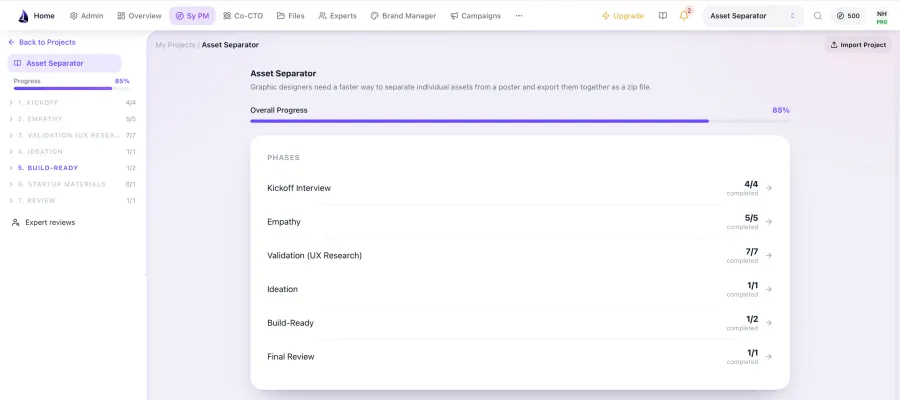
Product Manager is Byblos AI’s guided AI product-management workflow, available through Free and paid plans at byblosai.app. It turns founder context into connected product artifacts across kickoff, empathy, validation, solution planning, and build-ready review. Its distinctive controls are explicit dependencies, evidence-linked confidence, stale-artifact warnings, human approvals, and a structured handoff into Co-CTO, not a promise that AI autonomously finds product-market fit.
Product Status: Free and Paid Beta Access
Implementation status and customer availability are different facts.
Update, 21 October 2026: Free offers a limited Product Manager starting workflow with no time limit and no card. Launch is available now in beta with self-serve signup and checkout, with no access request. Grow and Byblos AI Pro need an access request and approval before checkout. Co-CTO (private beta) is included in Grow and Pro: it turns your roadmap into technical decisions and GitHub issues, and reviews pull requests, while your developers or coding agents implement the software. See Byblos AI plans and access.
Byblos AI is also live on Product Hunt, where you can follow the launch, leave feedback, and support the team.
This article explains the implemented product model and our product-management perspective. It does not announce general availability, guarantee a business outcome, or claim that every authenticated browser path and external research source has been verified for every customer environment. The Byblos AI Agent Solutions page remains the reference for plan scope and rollout status.
The Startup Problem We Are Solving
Startups rarely lack ideas. They lack a durable chain between:
- the founder’s original problem;
- what potential users actually reveal;
- the assumptions that survive validation;
- the product definition;
- the roadmap engineering receives;
- the reasons decisions changed.
When that chain lives in conversations and disconnected documents, teams can move quickly while losing the logic behind the work. A polished PRD may still rest on an untested assumption. A roadmap may look decisive while nobody can explain why one item outranks another.
Our view is that AI product management should make the chain more inspectable, not merely generate more documents.
Product Manager Scope and Limits
Product Manager is a phase-driven workspace linked to a canonical Byblos AI project. It combines structured data, AI-assisted generation and editing, artifact dependencies, approval state, and project context.
It is designed to help a founder or product lead:
- capture the problem, audience, market, and constraints;
- structure market and competitor analysis;
- build a lean canvas and personas;
- plan and analyze validation work;
- form a solution plan;
- produce and review build-ready artifacts;
- hand approved context to technical planning.
Product Manager is not:
- an autonomous founder;
- a substitute for real customer research;
- a guarantee of product-market fit;
- a source of unquestionable market facts;
- an automatic authority over roadmap decisions;
- a complete release-management or campaign-optimization system.
Humans remain responsible for evidence quality and consequential decisions.
The Workflow From Idea to Build-Ready Context
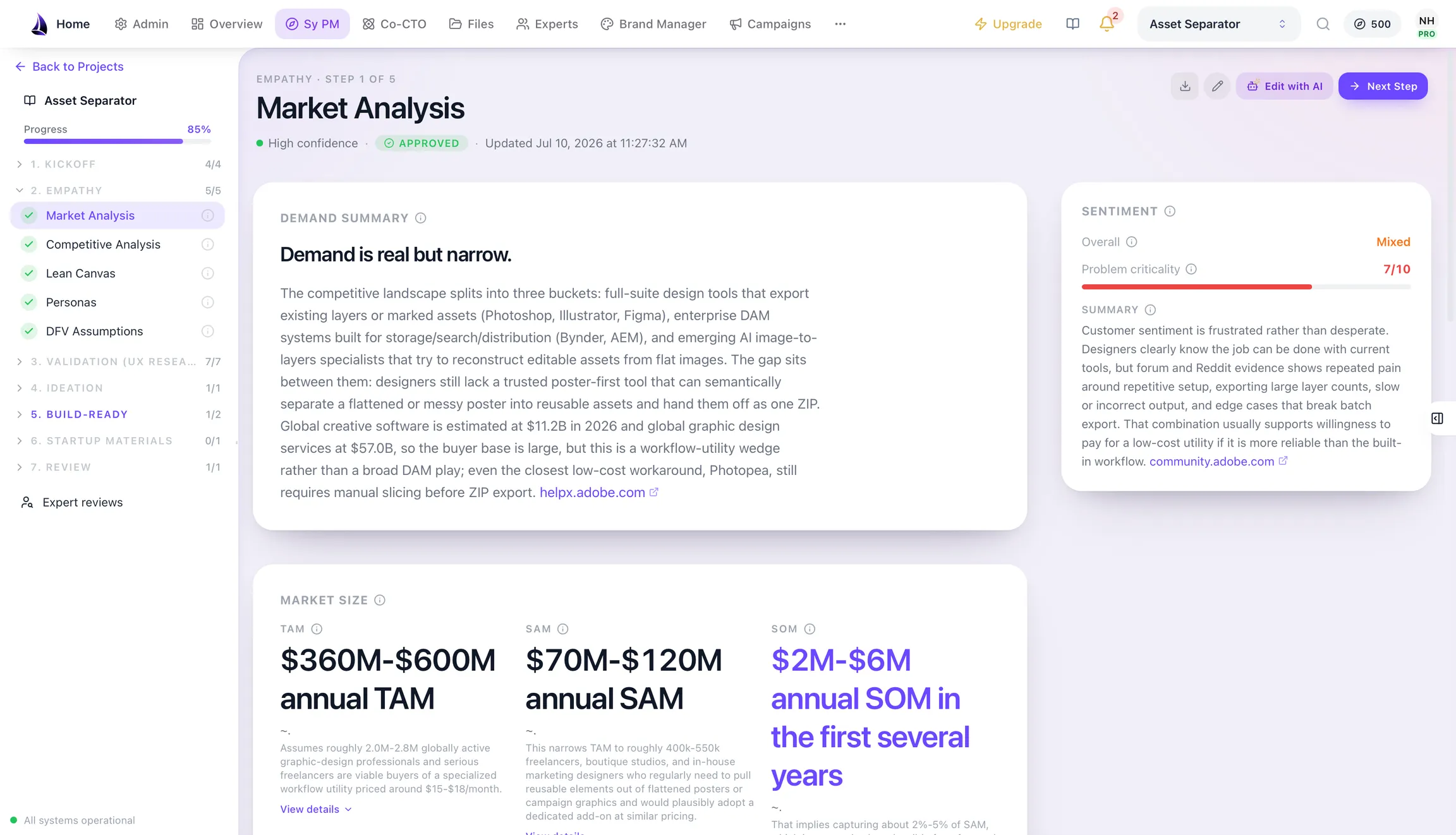
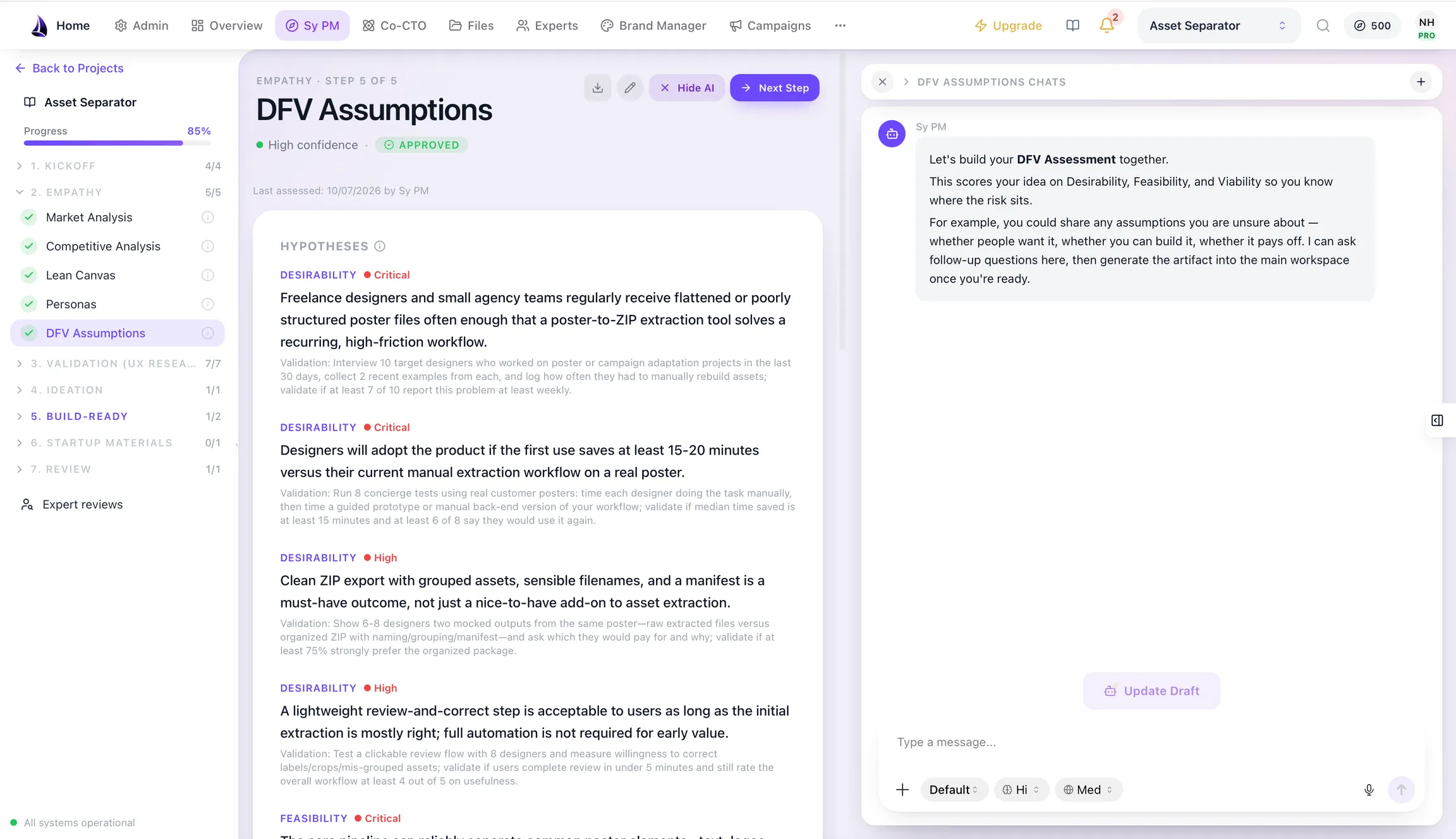
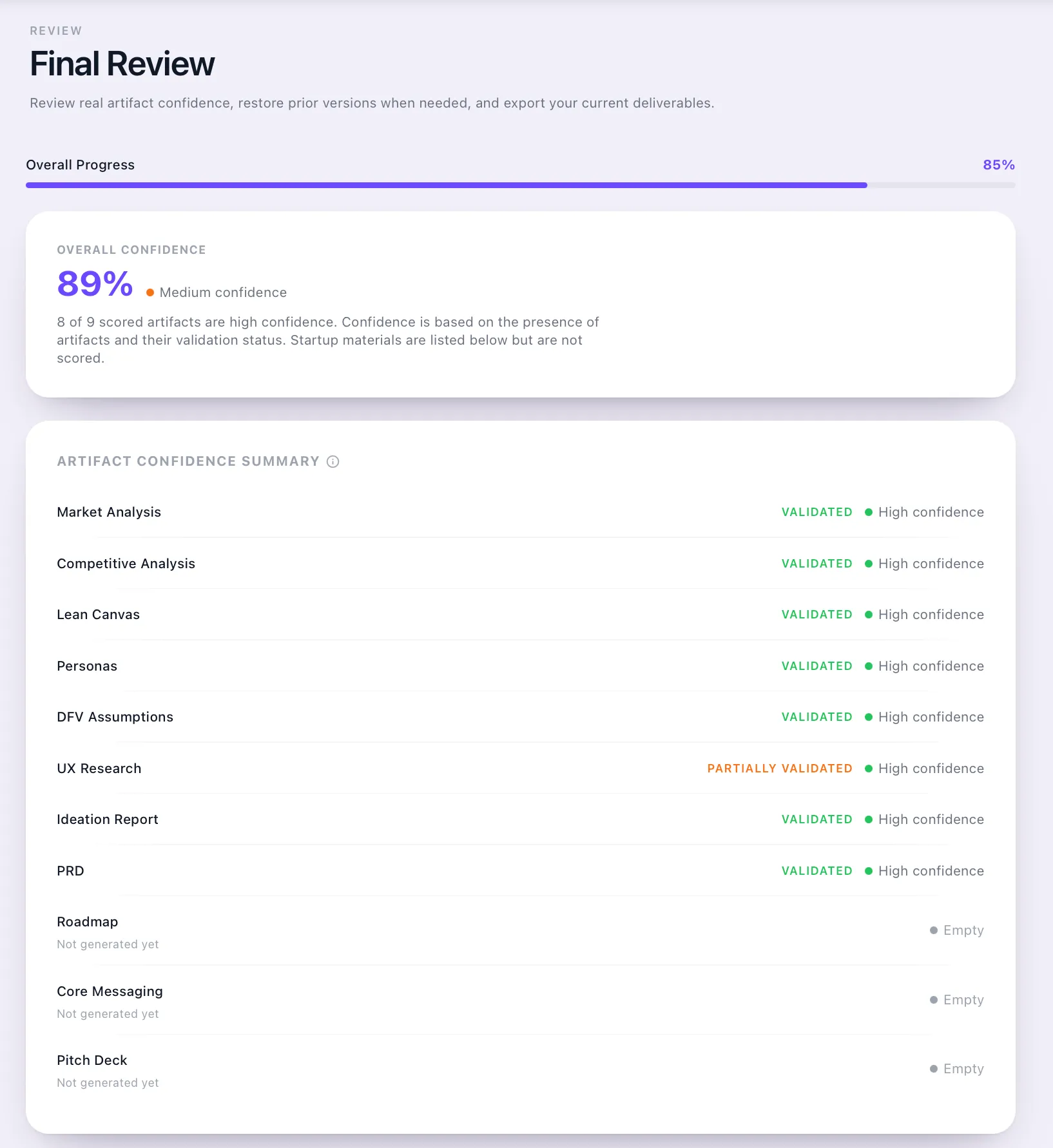
The screenshots in this article show the Asset Separator demo project with sample data.
1. Kickoff
The kickoff captures the founder definition: problem, audiences, market, geography, constraints, and other project context.
Our implementation deliberately reuses canonical project fields instead of creating a second, conflicting product-definition store. This reflects a broader code convention in ByblosAI: shared information should have one owner, and product modules should consume or adapt it rather than silently duplicate it.
2. Empathy and Market Context
The empathy stage can produce:
- market analysis;
- competitive analysis;
- lean canvas;
- personas;
- desirability, feasibility, and viability inputs where the plan enables them.
AI can help structure and draft this work, but a generated market analysis is not automatically verified market research. Users should review sources, dates, sample quality, and assumptions.
3. Validation
Product Manager supports interview answers, survey collection, survey analysis, and UX reporting. Validation outcomes can be attached to particular artifacts or fields with verdicts such as:
- confirmed;
- partially confirmed;
- refuted;
- inconclusive;
- not tested.
That model is important because “we ran interviews” is not the same as “the assumption was confirmed.” The workflow keeps the evidence and verdict visible.
4. Solution Planning
The founder-facing ideation output is a Solution Plan. It uses approved and available context from earlier phases rather than starting from a blank prompt.
This is where the team can explore:
- the product direction;
- the main capabilities;
- dependencies;
- sequencing;
- trade-offs;
- what should remain out of scope.
The solution remains a proposal until a human accepts it.
5. Build-Ready Review
The implemented build-ready flow centers on the PRD and canonical roadmap, with approval gates and a final review. Additional artifact contracts exist for backlog and UX guidance, but some substages can be plan-gated or deactivated in the current product configuration.
We make that distinction because a type or generator existing in code does not necessarily mean the feature is exposed in every plan or live user flow.
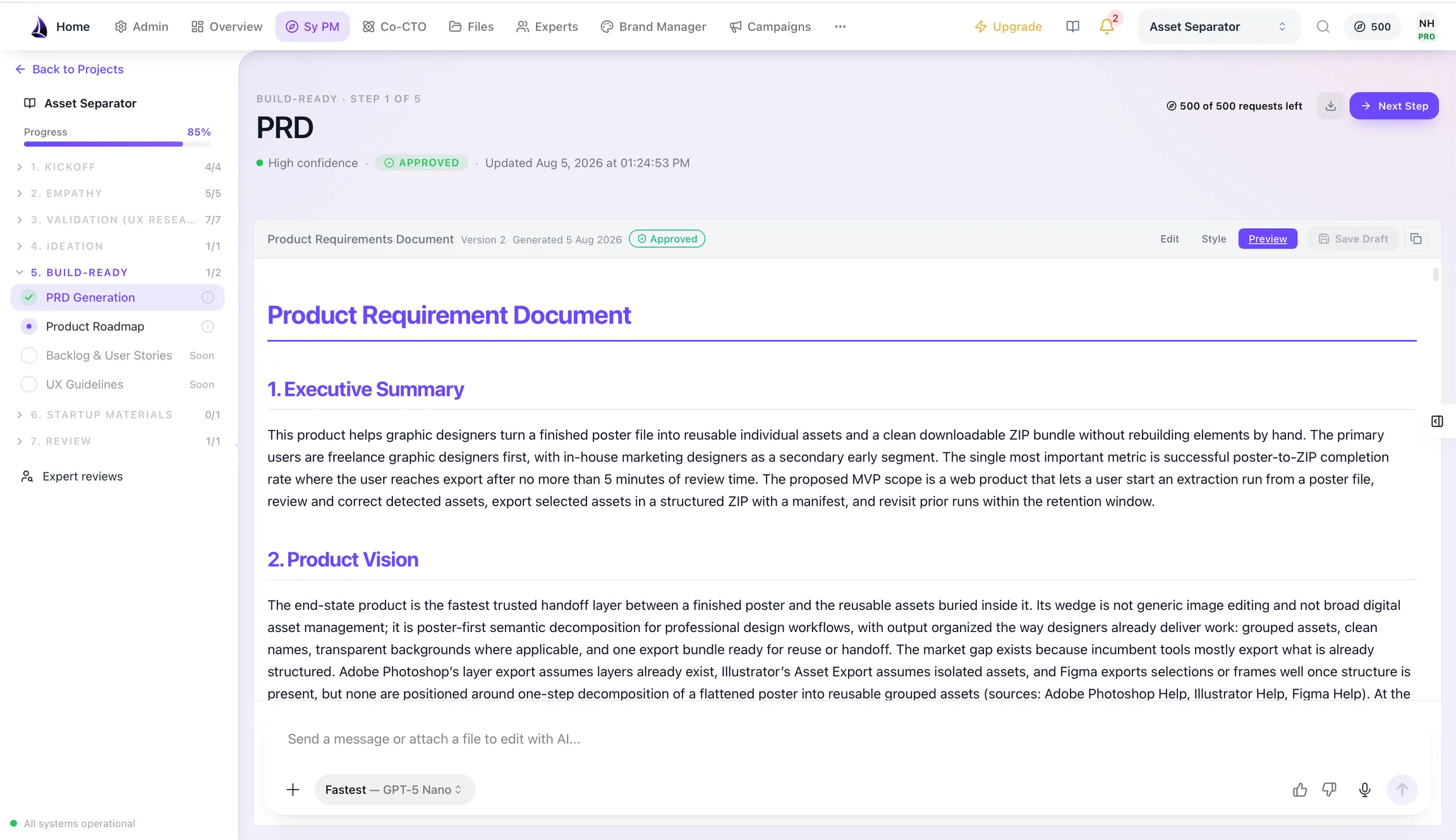
The Artifact Dependency Graph
Product Manager models artifacts as a directed graph.
Some relationships are hard prerequisites. A downstream artifact cannot be generated until the required inputs exist. Other relationships provide soft context: they improve the prompt when present but do not block generation.
Examples include:
Kickoff summary
  ├─ Market analysis
  ├─ Competitive analysis
  └─ Lean canvas
       ├─ Personas
       ├─ Validation context
       └─ Solution Plan
            ├─ PRD
            └─ Roadmap
This is not a universal product-management standard. It is our product architecture for keeping outputs connected and reviewable.
Why Staleness Matters
Suppose a team approves a persona, generates a PRD, and builds a roadmap. Later, new research changes the target audience.
A document-only workflow can leave the PRD looking current. Product Manager propagates staleness through the dependency graph so downstream artifacts can be reviewed again.
The warning does not automatically rewrite approved work. That is deliberate. Automatic silent rewriting would erase decision history and could introduce changes the team never accepted.
Our preferred sequence is:
- upstream evidence changes;
- affected downstream artifacts are marked stale;
- the team reviews the impact;
- AI can propose revisions;
- a human approves the new version.
Confidence Is Evidence-Aware
Product Manager uses confidence states to show whether an artifact is:
- empty or missing required context;
- affected by unresolved contradictions or overrides;
- approved but stale;
- current and conflict-free.
Confidence is a product signal, not a statistical guarantee. A “high” state means the workflow’s defined conditions have been met; it does not prove the underlying business assumption is objectively true.
We prefer that honest boundary to an unexplained AI confidence percentage.
Human Approval Is Part of the Data Model
Build-ready artifacts are decisions, not automatically testable hypotheses. Product Manager records explicit approval state and revokes approvals when upstream changes make an artifact stale.
That supports an important principle in our software work:
AI can prepare and challenge a decision; authority remains with the accountable person.
For a founder, that means the system can propose positioning, a roadmap, or acceptance criteria. The founder or product lead owns the trade-off.
The Co-CTO Handoff
Product Manager includes a structured handoff into Co-CTO. The handoff validates that required product context exists and packages the build-ready information for technical planning.
The relationship is intentionally asymmetric:
- Product Manager owns product intent, evidence, and priorities.
- Co-CTO owns technical solution guidance: it turns the roadmap into technical decisions and GitHub issues, and reviews pull requests. Your developers or coding agents implement the software.
This resembles our repository architecture: each module has a defined owner, and integration uses an explicit contract rather than direct access to every internal detail.
Read Co-CTO: Practical AI Technical Leadership for Startups for the technical side of this handoff, and check the Co-CTO product page for current availability.
What Product Manager Shares With Other Modules
Product Manager reuses canonical project and brand fields. Campaign Manager can consume approved Product Manager context when creating social content, and Brand Manager can provide shared brand information used by product artifacts.
We do not claim that campaign analytics automatically rewrite the Product Manager roadmap. An automated closed-loop product reprioritization flow would require an explicit contract, evidence model, and human approval. It is not part of this article’s verified capability claim.
A Practical Founder Workflow
Before Using AI
Prepare:
- the problem in plain language;
- known user groups;
- geography and regulatory constraints;
- evidence already collected;
- assumptions you are least confident about;
- business and delivery constraints.
During the Workflow
- Challenge generated facts and competitor claims.
- Separate user evidence from team opinion.
- Record refuted and inconclusive outcomes.
- Review stale warnings instead of blindly regenerating.
- Approve only the artifacts you are prepared to defend.
Before Engineering Handoff
- Confirm the PRD reflects current evidence.
- Confirm the roadmap depends on an approved PRD.
- Mark unresolved questions explicitly.
- Keep deactivated or plan-gated artifacts out of promises.
- Send the validated handoff to Co-CTO for technical pressure testing.
What Comes From Our Perspective
The following are design opinions we apply in ByblosAI:
- One canonical owner for shared data.
- Artifacts should show their dependencies.
- Upstream changes should make downstream uncertainty visible.
- Confidence must be explained by workflow state and evidence.
- AI suggestions should not silently overwrite human approvals.
- Product and technical leadership need an explicit handoff contract.
- Implementation, entitlement, browser verification, and public availability are different statuses.
These are not universal product-management laws. They are the practices we chose after building and testing a complex multi-stage workflow.
Try Product Manager on a Real Project
Product Manager is open to early teams right now, and the fastest way to judge a product-management workflow is to run your own idea through it.
- Start Free or sign up for Launch at byblosai.app, or request access to Grow or Pro.
- Run the kickoff with a real problem, audience, and constraint set, not a toy example.
- Push through to a Solution Plan and watch how dependencies, evidence, and confidence states behave when you change an upstream artifact.
- Tell us where it breaks. Specific feedback shapes the next workflow improvements.
If Product Manager earns it, support Byblos AI on Product Hunt. An upvote and an honest review help other founders find the product manager, and they tell us which parts of the workflow matter most.
Key Takeaways
- Product Manager is a guided product-management workflow, not an autonomous product executive.
- It connects kickoff, empathy, validation, solution planning, build-ready review, and Co-CTO handoff.
- Dependencies, staleness, confidence, and approval state make the reasoning inspectable.
- Generated research still requires source and evidence review.
- Free and paid beta plans provide different workflow depth; check current plan scope before choosing a paid plan.
Frequently Asked Questions
Does Product Manager replace a product manager?
No. It structures work, preserves context, and assists with artifacts. A founder or product lead remains responsible for research quality, strategy, prioritization, and approval.
Does Product Manager automatically validate an idea?
No. It can structure hypotheses, research plans, evidence, and verdicts. Validation depends on real observations and the quality of the data provided.
What happens when an earlier artifact changes?
Affected downstream artifacts can be marked stale. The system surfaces the dependency so the team can review and approve revisions.
Is Product Manager publicly available?
Free provides a limited starting workflow. Launch is available now in beta with self-serve signup and checkout. Grow and Byblos AI Pro provide expanded access after an access request and approval before checkout. Consult the Byblos AI plans for scope and access.
How do I get access?
Start Free or sign up for Launch at byblosai.app; Grow and Pro need an access request. You can also follow the launch, ask questions, and support the team on Product Hunt.
Conclusion
The most useful AI product manager is not the one that writes the most documents. It is the one that helps a team keep evidence, assumptions, artifacts, dependencies, and decisions aligned.
That is the perspective behind Product Manager. We use AI to accelerate structured work while keeping uncertainty visible and authority human.
Try it on a real idea. Start Free or sign up for Launch at byblosai.app, or request access to Grow or Pro. Bring a problem you actually care about, take it through kickoff, validation, and build-ready review, and tell us what holds up. If it helps you, back Byblos AI on Product Hunt so more founders find it.
You can also explore Byblos AI Agent Solutions, read our broader agentic software-delivery standards, or contact us to discuss your product workflow.