· Updated · StartMeUp AI · 8 min read
Co-CTO: Practical AI Technical Leadership for Startups
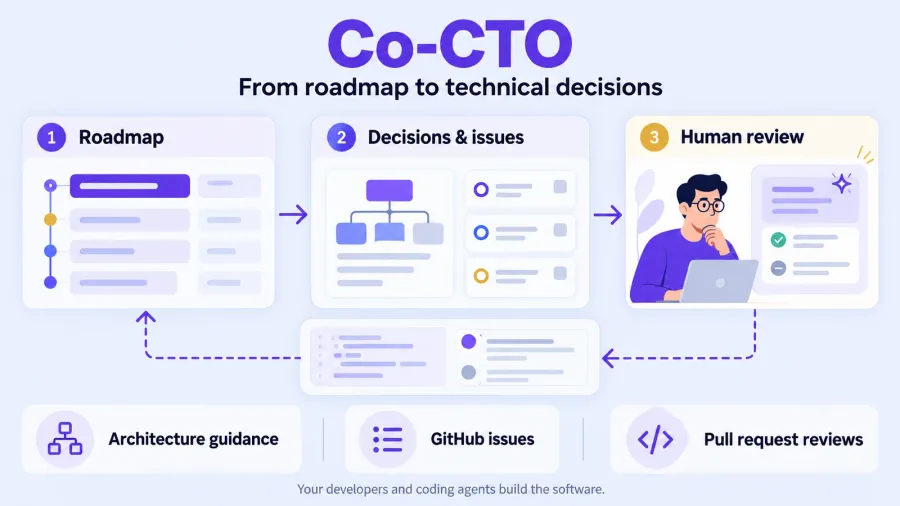
Co-CTO is ByblosAI’s AI-assisted technical leadership workspace, in private beta on Grow and Pro. It turns your roadmap into technical decisions and GitHub issues, and reviews pull requests, using shared project context and evidence. Your developers or coding agents implement the software. It supports technical decisions; it does not become a legal officer, guarantee production readiness, or replace the accountable CTO, engineering lead, security reviewer, or release approver.
Product Status and Evidence Boundary
Update, 21 October 2026: Free needs no card and has no time limit. Launch is available now in beta with self-serve signup and checkout, with no access request. Grow and Byblos AI Pro need an access request and approval before checkout. Co-CTO (private beta) is included in Grow and Pro: it turns your roadmap into technical decisions and GitHub issues, and reviews pull requests, while your developers or coding agents implement the software. Video Studio is in private beta on Pro and coming soon for Launch and Grow. Human experts are in early access: browse experts on any plan, message or invite them on paid plans, and yearly Pro includes two human reviews; review-credit purchases, in-app contracts and payments to experts are not available. Production Foundation is available by request. See Byblos AI plans and access.
The Co-CTO module contains project-scoped technical workflows. Access depends on the approved plan, connected repository and configured providers.
This article explains the implemented architecture and the technical-leadership practices behind it. It does not claim:
- general availability;
- that every provider integration is live for every project;
- that generated reviews replace human review;
- that a passing automated gate proves production behavior;
- that AI can accept executive or regulatory accountability.
Availability, plans, and rollout should always be checked against the current product pages.
Why Technical Leadership Needs Structure
A startup technical lead has to keep several systems aligned:
- product intent;
- architecture;
- delivery sequencing;
- code and test quality;
- security;
- deployment state;
- observability;
- infrastructure and AI usage;
- executive reporting.
The problem is not simply a shortage of advice. Generic advice is abundant. The challenge is maintaining project-specific context and showing which conclusions are supported by evidence.
Our view is that an AI technical-leadership product should not issue impressive verdicts from a blank prompt. It should organize decisions, sources, gates, and next actions around the real project.
What Co-CTO Is
Co-CTO is a project-scoped workspace with nine main areas:
- command centre;
- project setup;
- architecture and integrations;
- code delivery;
- quality and security;
- deployments;
- monitoring;
- finance and usage;
- reports.
The module integrates AI-assisted tools with project state, GitHub context, plan entitlements, and quality gates.
These are implemented product areas. Their live usefulness still depends on configuration, repository access, provider credentials, plan access, and the specific operation being exercised.
What Co-CTO Is Not
The name is deliberately ambitious, so the boundary must be equally clear.
Co-CTO is not:
- a human company director;
- an autonomous production operator;
- a guarantee that generated architecture is correct;
- a substitute for penetration testing or a formal security audit;
- an authority to merge, deploy, purchase, or waive risk without approval;
- a source of universal cost or delivery estimates;
- a replacement for experienced technical leadership in high-consequence decisions.
We use “Co-CTO” to describe the breadth and continuity of the assistance, not to transfer accountability to software.
The Nine Technical Workspaces
1. CTO Command Centre
The command centre summarizes project health, priorities, quality gates, recent activity, and recommended next actions.
Our preference is to surface a small number of explainable priorities rather than a vague “health score.” A priority should identify:
- the evidence;
- the affected project area;
- the consequence;
- the recommended action;
- the person who decides.
2. Project Setup
Setup tracks repository connection, team context, stack information, and readiness inputs.
This is important because AI recommendations without repository and environment context tend to be generic. The setup stage establishes what the system knows and what remains missing.
3. Architecture and Integrations
The architecture area supports technical-solution work, integration review, dependency decisions, and evidence-based gates.
In our own ByblosAI repository, architectural guidance includes rules such as:
- strict TypeScript and no new
any; - no barrel re-export modules;
- database operations stay in the database layer;
- shared tiers depend in one direction;
- product-specific adapters stay outside shared core code;
- reusable components and workflows should be inspected before adding new ones.
Those are not universal software laws. They are project-specific constraints. A useful Co-CTO must apply the project’s rules rather than impose them on every stack.
4. Code Delivery
The delivery area includes project work, GitHub issue synchronization, pull-request analysis, commit risk, and test planning.
AI can help:
- identify likely regression surfaces;
- relate changes to project standards;
- suggest missing test categories;
- summarize a diff;
- prepare review questions;
- turn approved planning into delivery tasks.
It cannot prove code quality merely by producing a review. The team still needs executable checks and human judgment.
5. Quality and Security
The quality area can organize:
- quality gates;
- testing evidence;
- standards checks;
- dependency and vulnerability findings;
- secret detection;
- compliance-oriented review;
- risk acceptance.
The wording matters:
- A scanner finding is a finding, not a confirmed exploit.
- No findings is not proof of no vulnerabilities.
- Unit tests are not browser proof.
- A mock provider is not a live provider.
- A human waiver must be recorded as a human decision.
This evidence discipline is one of the strongest conventions in how we work.
6. Deployments
The deployment area tracks provider configuration, release readiness, deployment state, and release notes.
Co-CTO does not run CI/CD pipelines or execute deployments. It can help review release readiness through technical decisions and pull request reviews, while your developers or coding agents, and your own pipelines, build, test and deploy the software.
We do not treat “deployment guidance exists” as “production deployment verified.”
7. Monitoring
Monitoring brings observability and health information into the technical view.
AI can help summarize logs, identify patterns, and propose investigations. It should preserve raw evidence and timestamps so a reviewer can distinguish observation from interpretation.
For an incident, the priority is a safe investigation and recovery path, not a confident root-cause narrative without evidence.
8. Finance and Usage
Technical leadership includes cost visibility. The finance and usage area can organize infrastructure and AI usage context, plan limits, and cost-related recommendations.
We avoid universal savings claims. A recommendation should name:
- the measured usage;
- the period;
- assumptions;
- possible trade-offs;
- what needs live confirmation.
9. Reports and Technical Solution
The reports area includes executive and engineering summaries and a Co-CTO-owned Technical Solution.
The Technical Solution uses a durable background-task framework and shared project context. That separation matters:
- Product Manager owns approved product intent and priorities.
- Co-CTO owns the technical solution.
- The handoff contract connects them.
This reduces the risk of two modules silently maintaining different technical definitions.
The Product Manager Handoff
Product Manager packages approved, build-ready product context for Co-CTO. Co-CTO can then examine:
- architecture options;
- integrations;
- delivery phases;
- quality and security gates;
- operational needs;
- unresolved technical risk.
This is decision support, not a closed autonomous loop. The founder or technical lead reviews the technical direction and trade-offs.
Read Product Manager: An AI Product Manager for Startup Delivery for the product side of the relationship.
An Illustrative Architecture Decision
The following example is hypothetical; it is not a customer benchmark.
A startup needs background media processing. Possible approaches include:
- processing in the web request;
- a durable task queue;
- a managed media provider;
- a serverless workflow.
A useful Co-CTO review would not announce one universal winner. It would compare:
| Factor | Questions |
|---|---|
| Workload | File size, duration, concurrency, retry behavior |
| Reliability | Idempotency, failure recovery, status persistence |
| Security | Signed access, authorization, provider credentials |
| Cost | Fixed and usage-based costs under measured volume |
| Operations | Monitoring, dead-letter handling, support burden |
| Portability | Provider lock-in and migration path |
The output is a reviewable decision record with evidence gaps, not a fabricated “three times cheaper” conclusion.
Our Technical-Leadership Conventions
The following practices come from how we build and review software:
Reuse Before Creation
Inspect existing components, stores, hooks, job systems, and authorization helpers before adding a second abstraction.
Explicit Ownership
Shared data and contracts have canonical owners. Integration happens through defined handoffs or adapters.
One-Way Architecture Boundaries
Shared foundations should not depend backward on product modules. This keeps reusable code reusable.
Typed and Validated Inputs
TypeScript helps at development time; runtime schemas validate untrusted boundaries.
Evidence-Typed Completion
Automated, browser, provider, production, and human evidence remain separate.
Human Authority
AI proposes. The accountable person approves architecture, risk, cost, and release decisions.
These are our conventions, not a substitute for the specific standards of another organization.
A Practical Co-CTO Review Cycle
- Load current project context.
- Identify the decision and accountable owner.
- Inspect repository and operational evidence.
- List assumptions and missing data.
- Compare options and consequences.
- Propose a recommendation with confidence boundaries.
- Define implementation and validation gates.
- Record the human decision.
- Revisit when upstream evidence changes.
The value comes from continuity and traceability, not the appearance of executive certainty.
When a Human Expert Is Still Essential
Use qualified human review for:
- regulated architecture;
- security and privacy assessments;
- material infrastructure commitments;
- contractual service levels;
- complex incident response;
- acquisition due diligence;
- risk acceptance;
- hiring and organizational decisions.
Byblos AI’s human expert directory is in early access and can complement agents in these situations. In-app contracts and payments to experts are not available.
Key Takeaways
- Co-CTO organizes nine areas of technical decision support.
- It applies project context and evidence; it does not replace accountable leadership.
- Product implementation and public availability are separate statuses.
- Quality gates must state what was actually tested.
- Our architecture practices of reuse, ownership, typed boundaries and truthful evidence shape the product’s recommendations.
Frequently Asked Questions
Is Co-CTO a replacement for a human CTO?
No. It assists with context, analysis, workflow, and evidence. Company authority and high-consequence technical judgment remain human responsibilities.
Can Co-CTO deploy software automatically?
No. Co-CTO does not run CI/CD or deploy software. It turns your roadmap into technical decisions and GitHub issues, and reviews pull requests; your developers or coding agents implement and deploy the software through your own pipelines.
Does Co-CTO perform security audits?
It can organize automated findings and AI-assisted review. Formal audits, penetration tests, compliance opinions, and risk acceptance require the appropriate human and technical process.
Is Co-CTO available now?
Co-CTO is in private beta and included in Grow and Byblos AI Pro, which need an access request and approval before checkout. See the Co-CTO page for scope and Byblos AI plans for access.
Conclusion
Technical leadership is a continuous evidence and decision process. Co-CTO is designed to make that process more structured, contextual, and reviewable for startup teams.
Our promise is not an autonomous executive. It is practical technical decision support built around explicit architecture, quality gates, project context, and human authority.
Explore AI Co-CTO, learn about ByblosAI Agent Solutions, read our external delivery standards, or contact us.