· Updated · StartMeUp AI · 9 min read
Brand Manager: Consistent Brand Systems at AI Speed
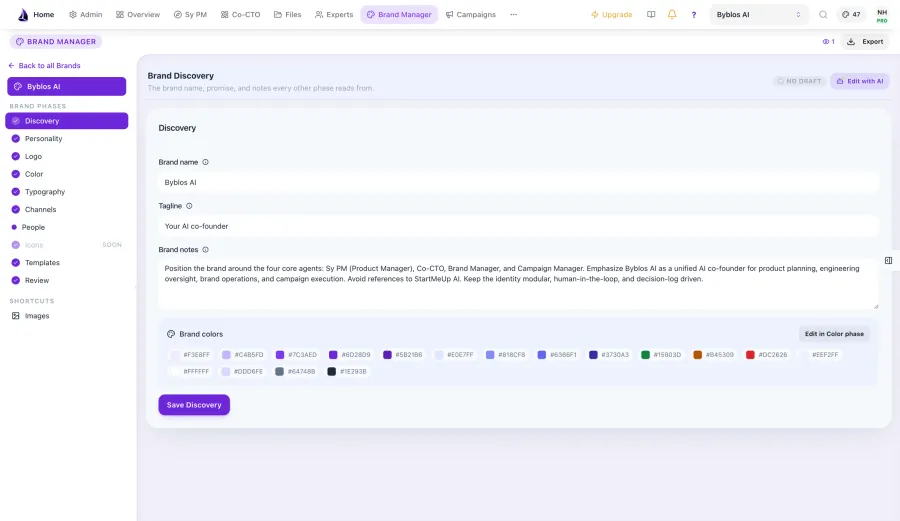
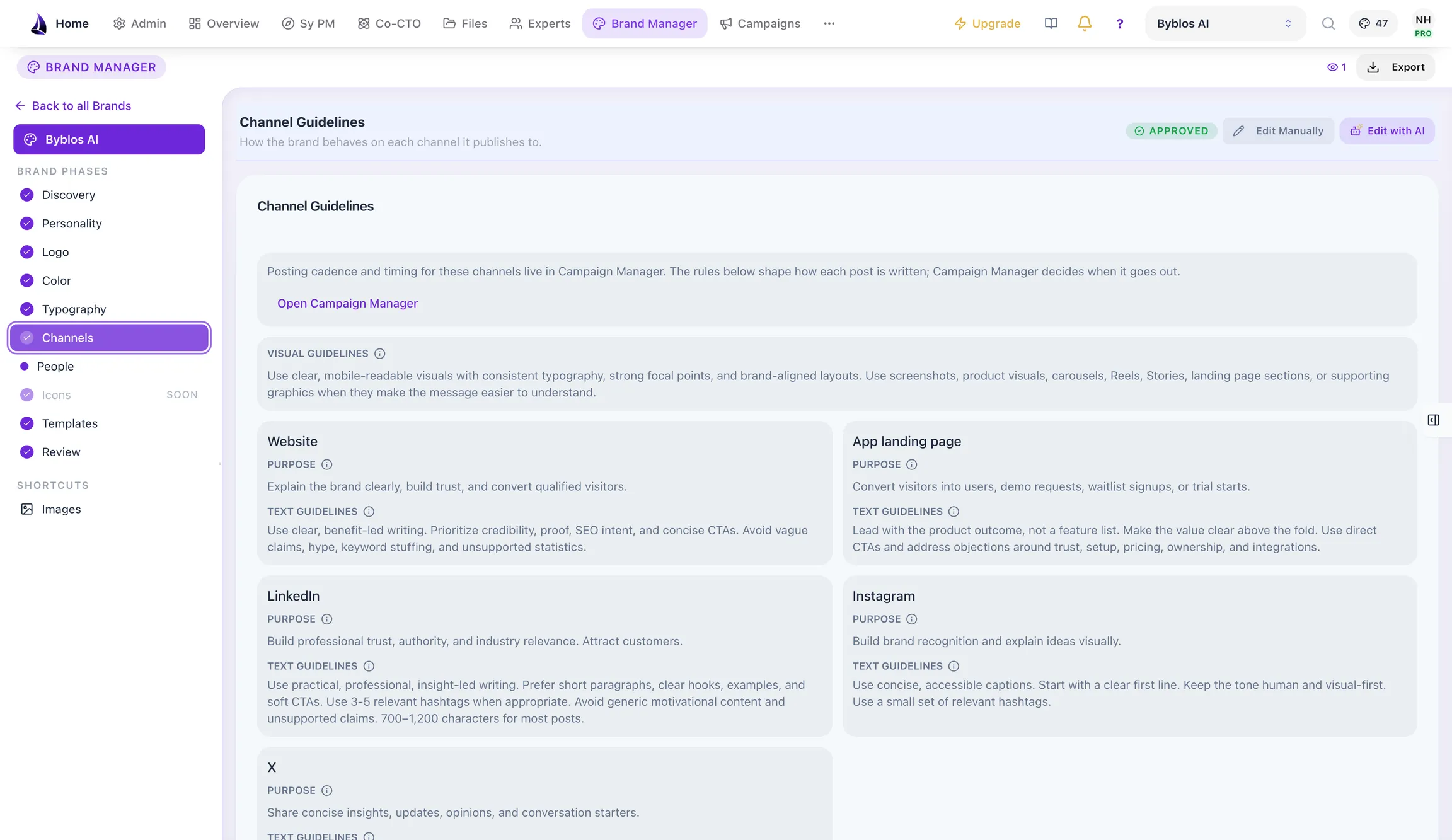
Brand Manager is ByblosAI’s phase-driven workspace for creating and maintaining structured brand artifacts. It converts approved colors, typography, voice, logos, assets, and templates into versioned brand tokens that downstream workflows can read. It improves consistency by sharing canonical context; it does not automatically guarantee that every generated output is on-brand.
What “Consistency” Actually Means
Brand consistency is often described as a creative discipline. In software, it is also a data and integration problem.
A startup’s brand can be spread across:
- a logo folder;
- a presentation;
- design-tool libraries;
- a color list in a message;
- website CSS;
- founder preferences;
- prompts used by different AI tools.
Each source can drift. AI generation makes that drift faster because every workflow can improvise a new tone, palette, or visual direction.
Our response is not to tell an AI model to “remember the brand.” It is to give brand information a canonical owner, a structured contract, an approval state, and explicit downstream consumers.
Product Status and Evidence Boundary
Brand Manager is active inside the ByblosAI application. Internal module documentation describes the main staged workflow and downstream token contract as implemented, while some finalization and runtime-verification work remains partial.
Update, 21 October 2026: Free includes Brand Manager brand discovery, personality and colour palette, with no card and no time limit. Launch, Grow and Byblos AI Pro include the full Brand Manager workflow alongside Product Manager and Campaign Manager. Launch is available now in beta with self-serve signup and checkout, with no access request; Grow and Pro need an access request and approval before checkout. See Brand Manager and Byblos AI plans and access.
This article describes the implemented brand-system architecture. It does not claim:
- that AI autonomously creates a defensible brand strategy;
- that every generated asset is automatically approved;
- that every ByblosAI module enforces every token;
- that a token contract controls typography in plain-text social posts;
- that public plan availability can be inferred from internal code.
The Brand Manager Workflow
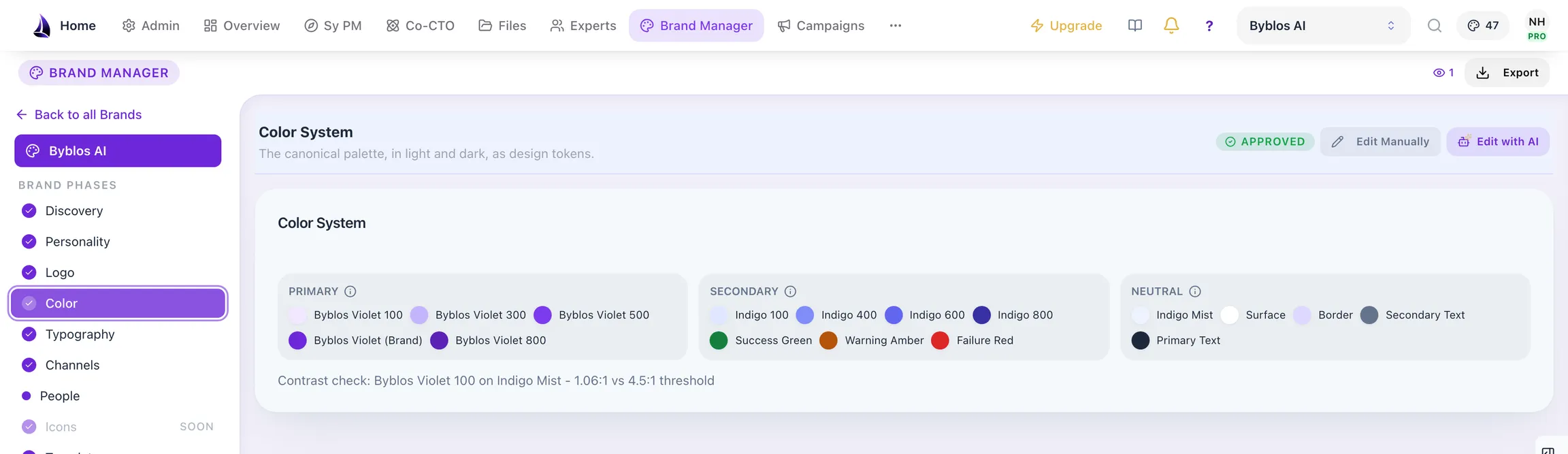
The workspace guides a project through brand phases covering areas such as:
- discovery;
- personality and voice;
- logo assets;
- color;
- typography;
- channel guidance;
- icons;
- templates;
- review and approval.
The exact set of phases and plan access can evolve. The stable architectural idea is that each phase produces structured artifacts rather than a disconnected conversation transcript.
The Canonical Brand Contract
Downstream modules can request a project’s brand tokens through a stable read contract.
The token model includes:
BrandTokens
├── colors
│   ├── light
│   └── dark (optional)
├── typography
│   ├── h1
│   ├── h2
│   ├── body
│   └── caption
├── voice
│   ├── preferred phrases
│   └── phrases to avoid
├── asset references
│   ├── logos
│   └── fonts
└── approval status
This is our product contract, not a universal brand-schema standard.
The contract is versioned. A breaking shape change requires a schema-version change, and automated tests protect the snapshot. That follows the same code style we use elsewhere in ByblosAI: consumers depend on explicit, typed boundaries rather than reaching into another module’s internal store.
Why Approval Status Travels With the Tokens
A draft brand should not look identical to an approved brand when another workflow consumes it.
Brand Manager includes approval state such as:
- draft;
- in review;
- approved.
Downstream previews can show a warning when the brand context is not approved. This does not technically prevent every use, and it is not a substitute for role-based permissions. It makes the state visible so a team can avoid treating exploratory choices as final.
Our recommendation is:
Generation can use draft context for exploration, but public publishing should require the appropriate human review and module-level authorization.
That is our governance opinion, not an Agent Skills or branding-industry standard.
Voice Tokens
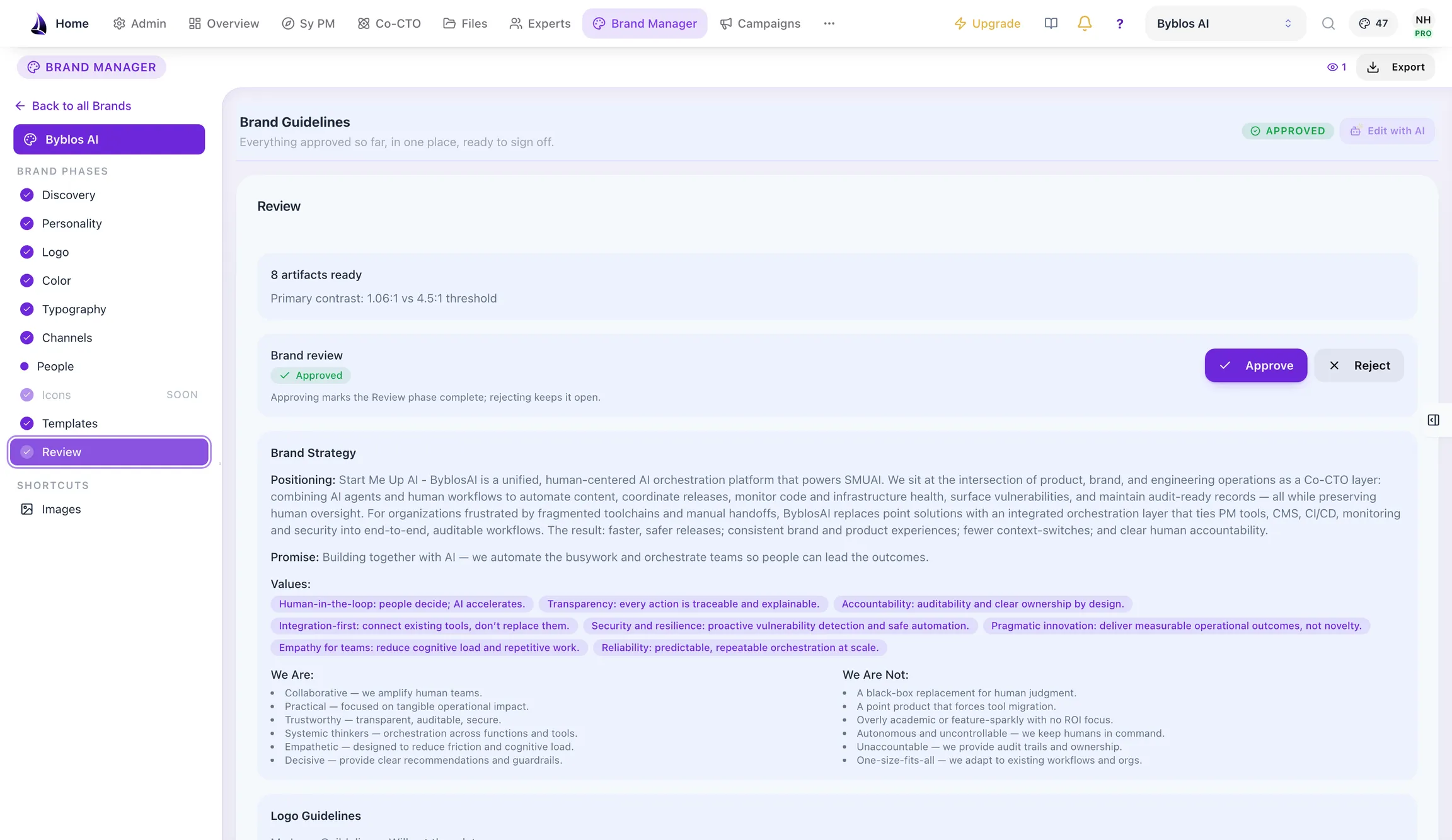
Voice guidance includes preferred and avoided phrases. This helps an AI content workflow move beyond a generic instruction such as “sound professional.”
Useful voice guidance is concrete:
Preferred:
- practical
- evidence-backed
- direct about limitations

Avoid:
- guaranteed
- revolutionary
- fully autonomous
- effortless
The tokens provide context. They do not guarantee adherence. The generating model, prompt, product surface, and human review still matter.
Color and Typography Tokens
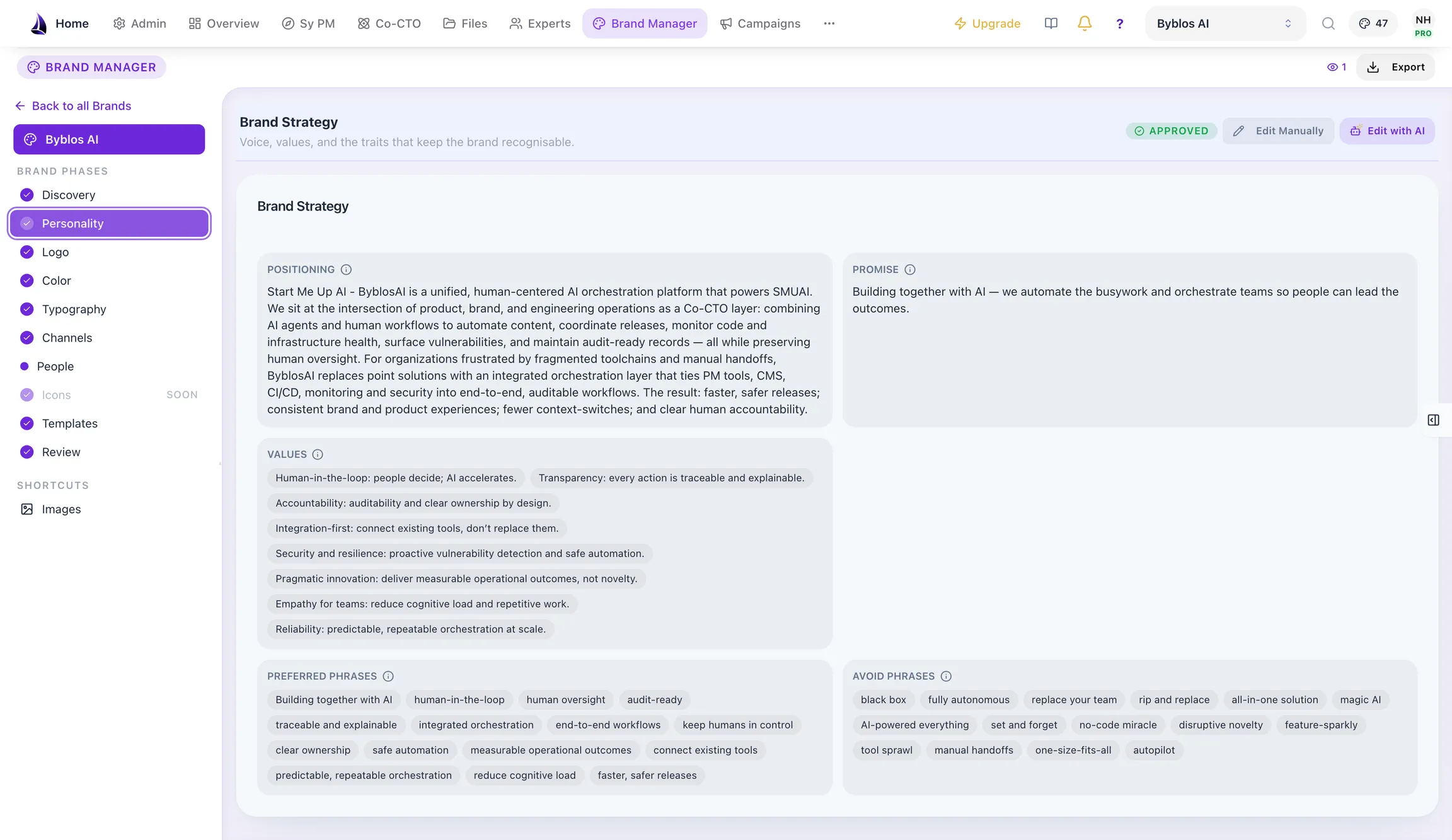
Structured color and typography information supports consistent visual generation and inspection.
Typography can carry role-specific values for headings, body copy, and captions. Brand Manager also supports:
- a curated font catalog;
- self-hosted font assets;
- user-supplied fonts within validated formats and limits;
- live preview;
- provenance;
- downstream font references.
The implementation self-hosts catalog fonts because the application’s content-security policy does not rely on loading Google Fonts at runtime. This is a project-specific technical decision, not advice that every brand platform must self-host fonts.
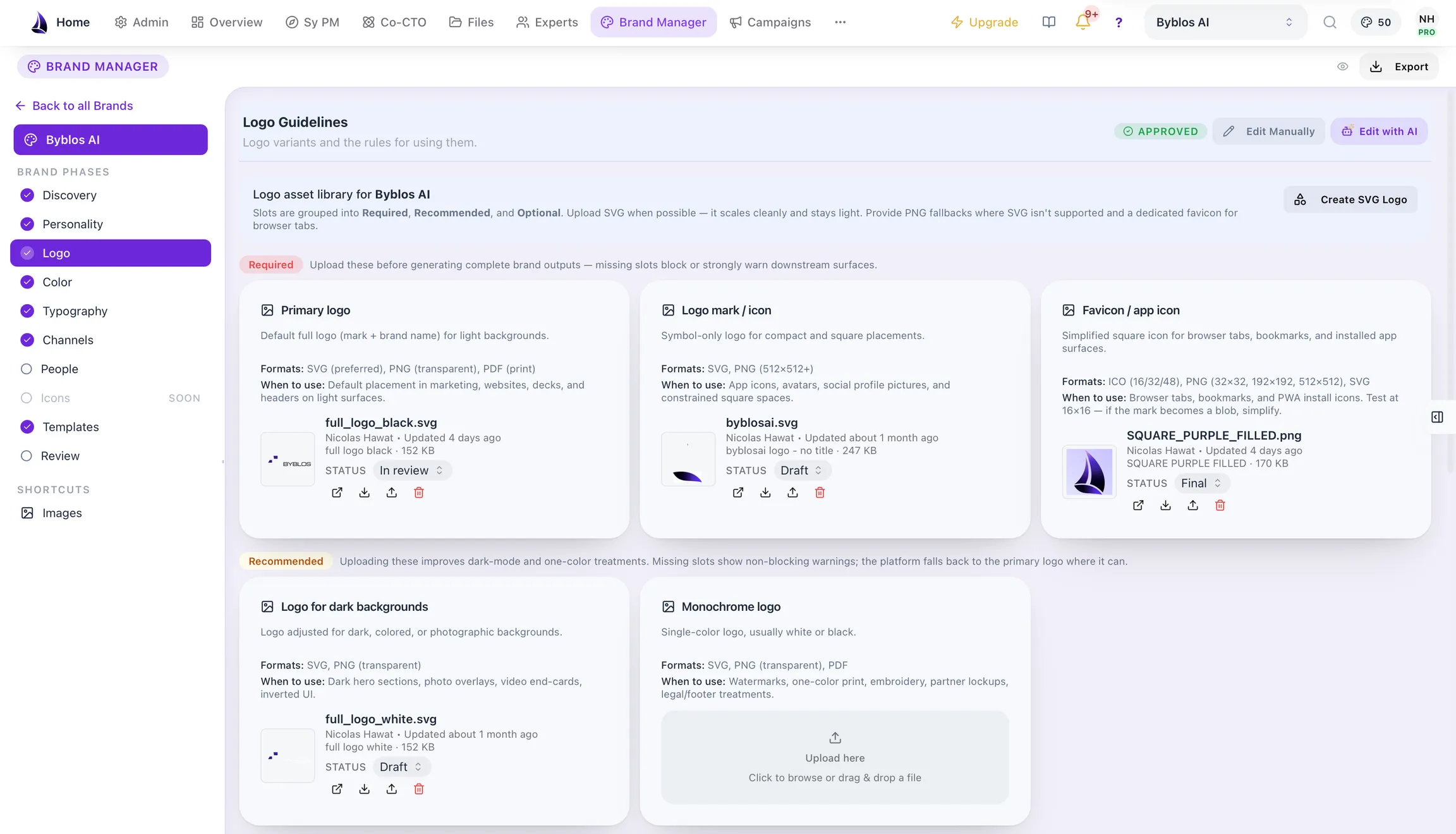
Logo Assets and Derived Variants
Brand Manager can manage a primary logo and derive practical variants such as:
- common PNG sizes;
- favicon formats;
- dark-background variants;
- social crops.
Derived variants reduce repetitive export work. They still require review:
- Is the contrast correct?
- Does the mark remain legible?
- Is padding appropriate?
- Does inversion preserve the intended design?
- Is the asset approved for the destination?
Format conversion is deterministic work. Visual judgment remains human.
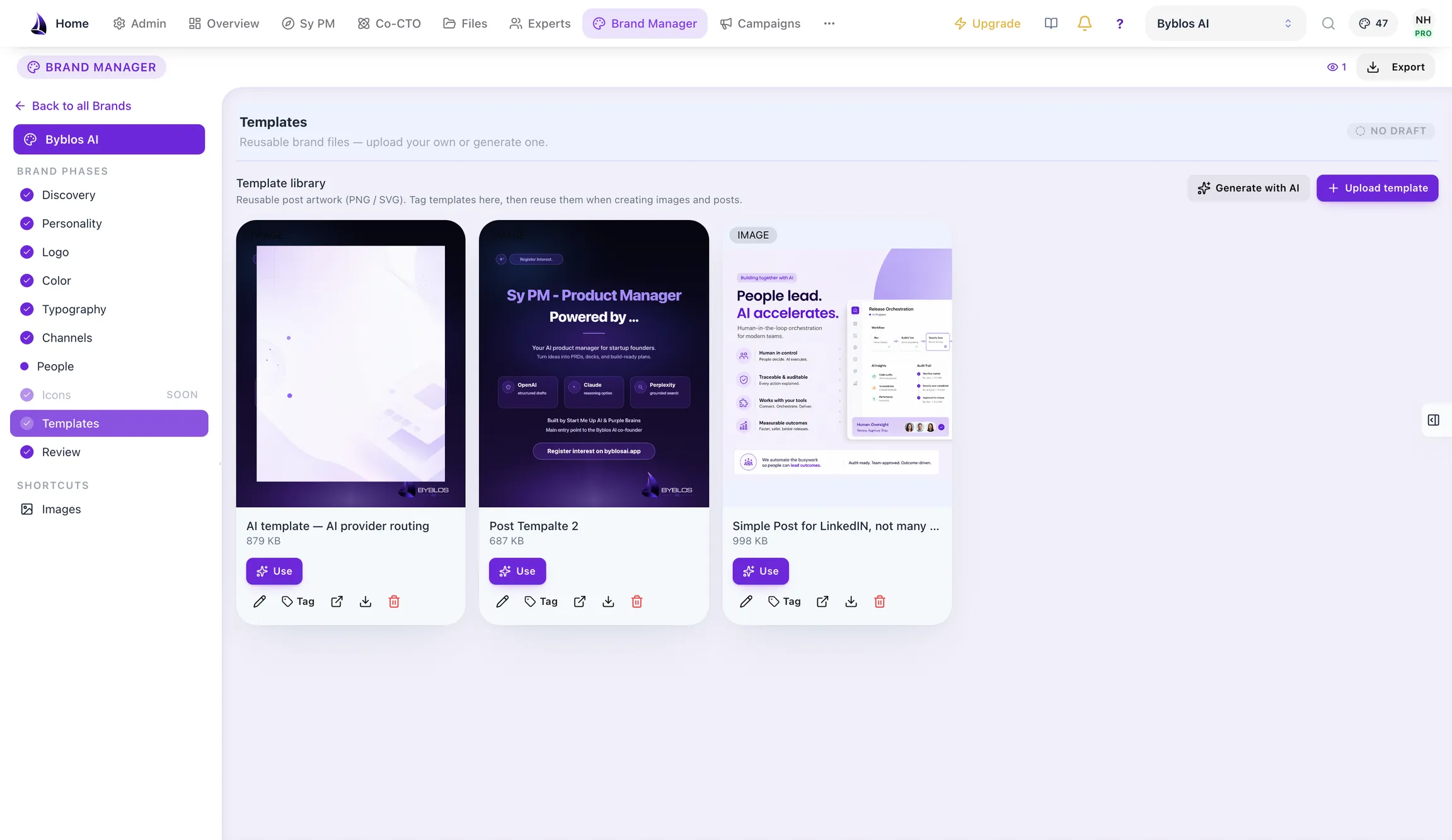
Templates and AI-Assisted Generation
The template workflow can generate a base visual layer and composite it with a server-owned canonical layout. It enforces authentication, project membership, edit permission, entitlement, quota, and duplicate-submission controls before generation.
That implementation reflects several of our engineering conventions:
- authorization is checked server-side;
- layouts come from a controlled allowlist;
- storage and database writes are coordinated;
- orphaned storage objects are cleaned up when persistence fails;
- provenance stays attached to the generated artifact.
The AI creates part of the visual input. The system still uses deterministic layout and persistence controls around it.
Sharing Brand Context With Campaign Manager
Campaign Manager can load Brand Manager context through an explicit handoff contract. That contract provides brand tokens or no context; it does not expose arbitrary Brand Manager internals.
The consuming workflow uses the context according to the medium:
- Text generation uses voice, tone, values, and personality.
- Image-prompt generation can use visual direction, colors, and typography context.
- Inspectors show which brand context is present.
Plain-text generation intentionally does not pretend it can render a font or enforce a hex color. Injecting visual tokens into a text-only model can add noise rather than control.
This is an example of context being useful only when the consumer can act on it.
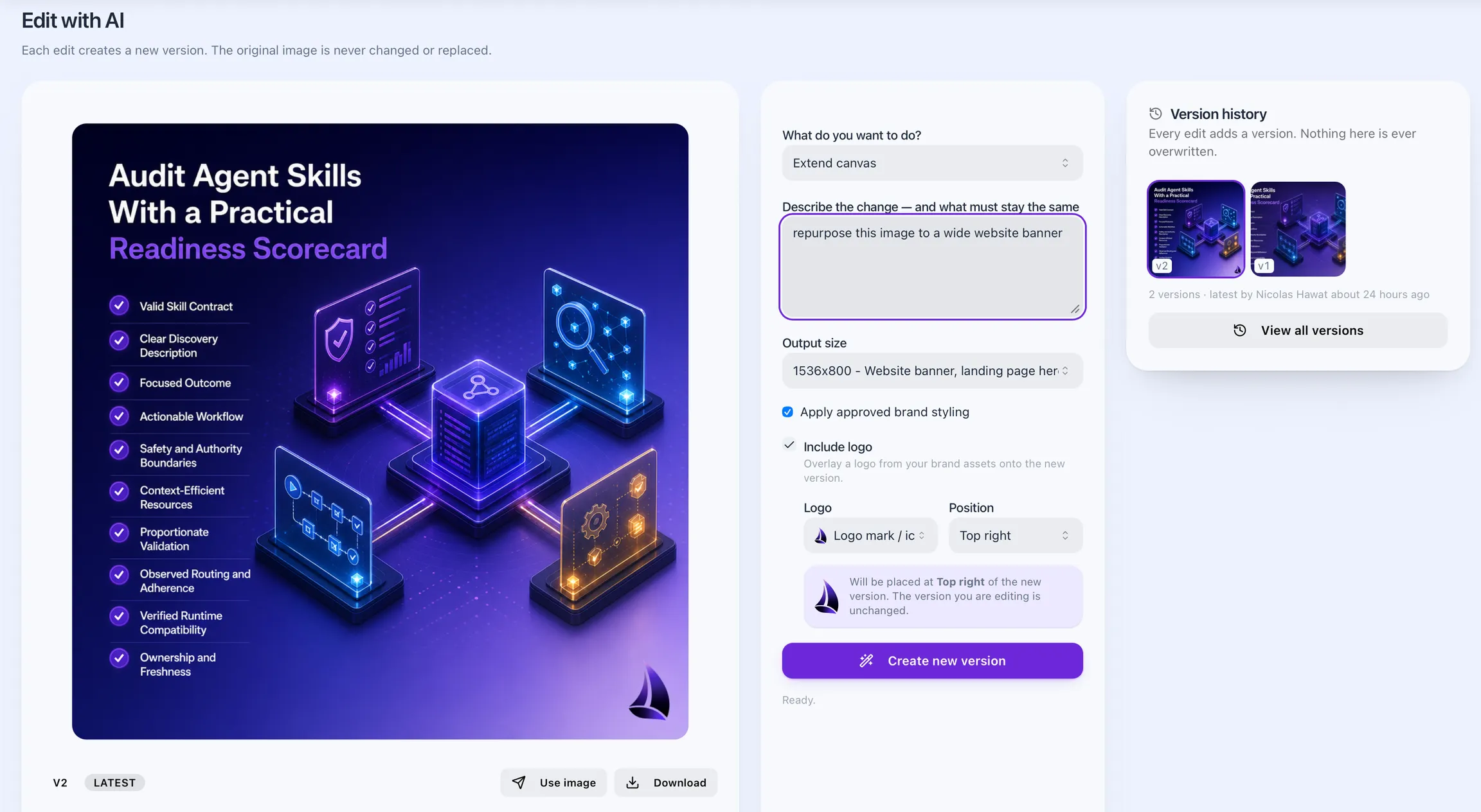
Brand context also reaches AI image editing. When a campaign visual is edited, the edit can apply approved brand styling and overlay a logo from the brand’s assets, and every edit creates a new version instead of overwriting the original.
Read Campaign Manager: AI-Assisted Social Campaign Operations for the downstream social-content workflow.
Sharing Product Context Without Duplicating It
Product Manager, Brand Manager, and Campaign Manager operate on the same project, but they should not each own a private copy of audience, product, and brand truth.
Our preferred ownership is:
- Product Manager structures product intent and evidence.
- Brand Manager owns structured brand artifacts and tokens.
- Campaign Manager consumes approved product and brand context for social content.
- Co-CTO owns technical-solution guidance.
The integration contracts matter as much as the AI models. They reduce hidden drift between modules.
What Brand Manager Cannot Guarantee
Automatic Universal Enforcement
A token contract helps only where a consumer integrates it. It does not automatically control external tools or every output.
Originality or Trademark Clearance
AI-assisted naming, logo, or template work still needs appropriate legal and creative review.
Accessible Contrast Everywhere
A palette can contain accessible combinations, but accessibility depends on actual foreground/background use, size, and context.
A Finished Brand Strategy
Structured artifacts support the process. They do not replace customer insight, positioning decisions, or experienced creative direction.
Public Availability
An active internal module is not the same as an unrestricted public release.
Our Brand-System Principles
The following are practices we recommend based on how we built the module:
- One canonical token contract.
- Typed handoffs instead of cross-module store access.
- Approval state travels with context.
- Consumers receive only useful signals for their medium.
- AI generation is surrounded by deterministic controls.
- Assets keep provenance.
- Draft context remains visibly draft.
- Human review closes the loop.
These are our engineering and product opinions. Other organizations may choose different phase models or token shapes.
A Practical Startup Workflow
Establish the Minimum Brand
Before generating a large system, define:
- audience;
- positioning;
- three to five voice traits;
- phrases to prefer and avoid;
- a usable primary and neutral palette;
- heading and body typography;
- primary logo assets.
Test in Real Context
Review the system in:
- a landing-page hero;
- a product screen;
- a social post;
- a presentation;
- light and dark backgrounds;
- mobile and desktop layouts.
Approve and Distribute
- mark the reviewed token set approved;
- keep drafts visibly separate;
- export or expose the canonical contract;
- integrate consumers explicitly;
- review generated output before publishing.
This process is more reliable than asking each AI tool to infer the brand from a logo.
Key Takeaways
- Brand Manager creates structured brand artifacts and a versioned token contract.
- Tokens improve consistency where consumers integrate them; they do not guarantee universal enforcement.
- Approval status, provenance, and typed handoffs make the context safer to reuse.
- Text and visual generation need different brand signals.
- AI-assisted assets still require creative, accessibility, and legal review.
Frequently Asked Questions
Does Brand Manager automatically approve generated assets?
No. Generation and approval are separate. Teams review and approve artifacts according to their roles and publishing process.
Can Brand Manager guarantee every Campaign Manager post is on-brand?
It supplies canonical context and inspectors. Actual adherence depends on the generation path, consumer integration, model output, and human approval.
Does it replace a brand strategist or designer?
No. It structures brand decisions and assets. Experienced human input remains important for positioning, originality, judgment, and high-stakes public work.
Is Brand Manager publicly available?
Yes. Free includes brand discovery, personality and colour palette. Launch, Grow and Pro include the full workflow: Launch is self-serve, while Grow and Pro need an access request and approval before checkout. See Byblos AI plans and access.
Conclusion
AI speed is useful only when the brand does not fragment in the process. Brand Manager addresses that by treating brand context as structured, approved, versioned product data rather than a paragraph copied into every prompt.
That is our perspective: make the creative system explicit, integrate it through typed contracts, and keep human review where judgment matters.
Explore ByblosAI, read about Product Manager and Co-CTO, or contact us.